Shop the look: seven tools compared (and why screenshots beat reverse image search)
Google Lens, Pinterest Lens, Amazon StyleSnap, ShopStyle, Screenshop, YesPlz, Looksharp — a head-to-head on the one thing that matters: can you buy the outfit tonight, in stock.
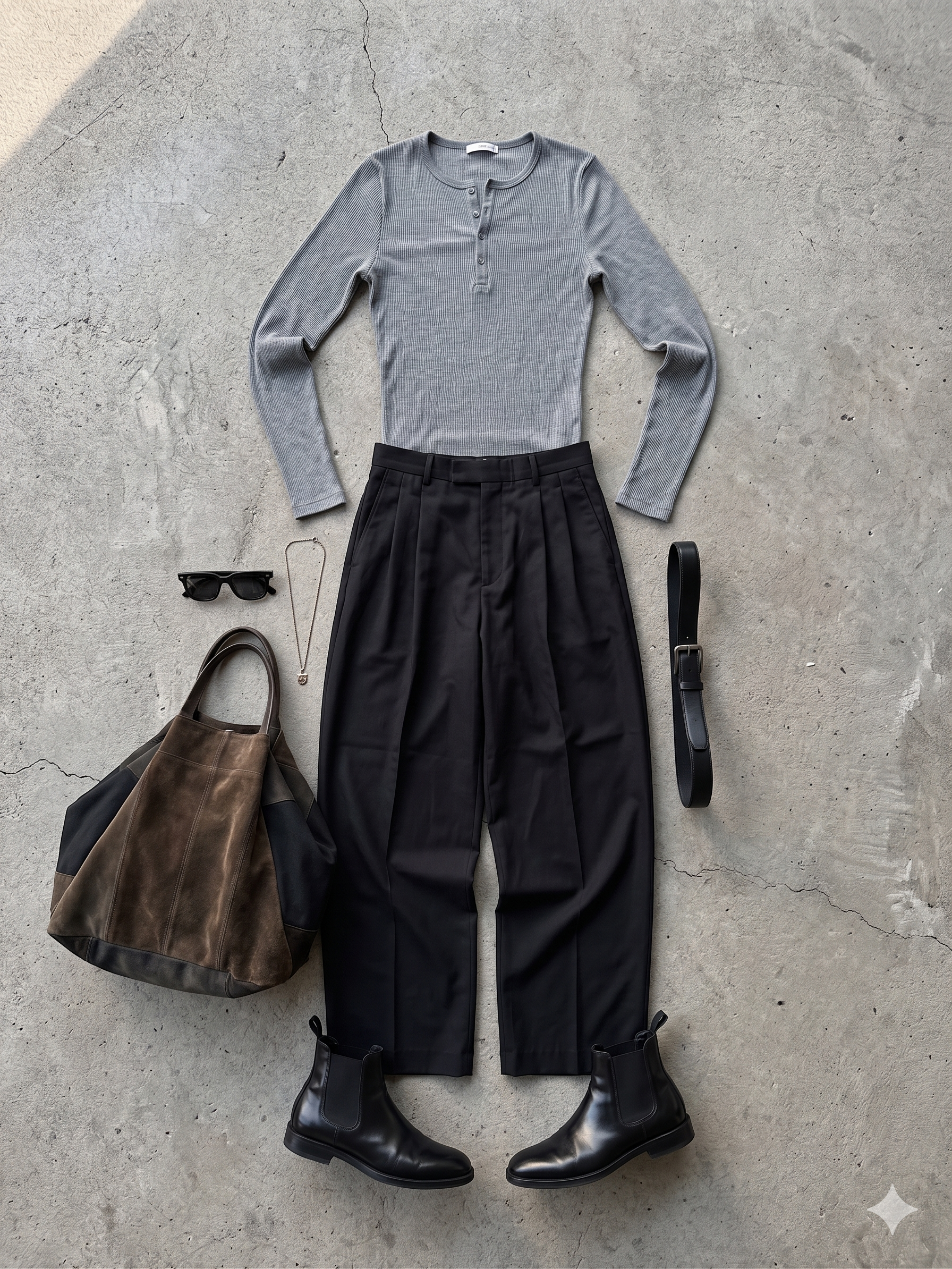
“Shop the look” is one of those phrases that means everything and nothing. Every fashion app promises it. Almost none of them deliver. We took a single Pinterest screenshot — a chestnut bomber over a cream turtleneck, washed jeans, black Chelsea boots — and ran it through seven tools that all claim to find the clothes for you. The test is simple: can you buy the outfit?
Not a visually similar jacket. Not a “people also bought.” The outfit. Priced, in stock, ready to save.
The scoring rubric
Every tool gets graded on four axes:
- Decomposition — does the tool split the outfit into separate garments, or does it just match “the whole picture?”
- Match quality — for each piece, how close is the top result to the actual garment in the photo?
- Live stock — does it check that the result is buyable right now, or does it send you to dead URLs?
- Free library — does the tool publish extracted fits to a free public gallery you can browse and save from, or does everything die behind your account?
Head-to-head: seven tools, four axes
| Tool | Decomposition | Match quality | Live stock | Free library |
|---|---|---|---|---|
| Google Lens | None | Decent on dominant garment | None | None |
| Pinterest Lens | Partial (some pins) | Editorial yes, screenshots no | None | Pins, not breakdowns |
| Amazon StyleSnap | Crude (most prominent piece) | Amazon catalogue lookalikes | Yes (Amazon) | None |
| ShopStyle | Manual (text-based) | Good for known brands | Mixed | Account-gated |
| Screenshop | Yes (per piece) | OK on top, weak on accessories | Partial | None |
| YesPlz | Yes (style-tagged) | Strong silhouette, weak brand | Variable | None |
| Looksharp | Every garment, bounded box | Live retailer match, reranked | Verified nightly | Yes — free public library |
1. Google Lens
Decomposition: none. Lens matches the full image and returns a grid of visually similar photos. You have to mentally decide which element you care about and click through twenty near-lookalikes. Match quality: decent for the dominant garment (usually the jacket), useless for layers or accessories. Live stock: no check; you click a result and find it out-of-stock yourself. Free library: none — Lens has no concept of a saved outfit.
Verdict: the default because it is free. Not because it works.
2. Pinterest Lens
Decomposition: partial — Pinterest sometimes offers “tap a product” hotspots on pins, but only on a fraction of images, almost never on user saves. Match quality: better than Lens for editorial shoots, worse for street screenshots. Live stock: no. Many matches link to dead Shopify stores. Free library: Pinterest itself is a library, but extracted-fit data is not — saves are images, not breakdowns.
Verdict: a recommendation engine dressed up as a shopping tool.
3. Amazon StyleSnap
Decomposition: yes, crudely — it picks the most prominent garment. Match quality: constrained to the Amazon catalogue, which means the results are cheap knockoffs that visually rhyme. Live stock: always (Amazon inventory). Free library: none — every result is a private product-page click.
Verdict: if you wanted an Amazon version of the fit, great. If you wanted the actual fit, no.
4. ShopStyle
Decomposition: manual — you tell it what you are looking for via text. Match quality: good for known brands. Live stock: mixed; catalogue freshness varies. Free library: account-gated favourites only.
Verdict: a search engine, not a shop-the-look tool. Works if you already know what you are looking for, which defeats the purpose.
5. Screenshop
Decomposition: yes — this was the first entrant to actually understand an outfit is a stack of pieces. Match quality: okay on the top piece, inconsistent on accessories. Live stock: partial. Free library: none — extractions die in the app.
Verdict: the product had the right idea five years ago. The execution has not kept up with what VLMs can now do.
6. YesPlz
Decomposition: yes, and with style-tag metadata (neckline, silhouette, length). Match quality: strong on silhouette, weak on exact brand. Live stock: variable. Free library: none — pro-tool walled garden.
Verdict: feels like a pro tool for buyers, not a consumer flow. The details are there but the experience is clinical.
7. Looksharp
Full disclosure: this is us. We built the thing because nothing above actually shipped a parcel. Decomposition: every garment separated with a bounding box, labelled, and searched individually. Match quality: the top bucket is the closest visual match in live inventory; two fallback buckets widen the net by price. Live stock: verified nightly, stale pages demoted. Free public library: every published fit is browsable and savable by anyone, no signup, no paywall — cleared against colour season (deep winter, soft autumn, etc) when the viewer has set one.
The demo runs on a screenshot in about eighteen seconds and returns a receipt with prices, retailers, and “shop this edit” buttons on each piece. That is the point.
The short version
Reverse image search (Lens, Pinterest Lens) is a lookup over the internet as a whole. It was never built for outfits — it was built for “what is this object.” Screenshot-to-outfit is a different problem: decompose the garments, match each one in a retail context, publish them to a savable, free library. If a tool does not do all four of those, it is doing a different job.
On our test screenshot, two tools (Looksharp and Screenshop) returned a buyable four-piece outfit. One of them verified live stock and published the edit to a free, savable library; the other did not. The rest returned somewhere between a grid of lookalikes and a recommendation engine.
Run Looksharp on your screenshot — credit packs from €5.99, never expire. Or browse the public library to see the output on a hundred real examples.
Related dispatches
- How to find clothes from a Pinterest screenshot — the four-step workflow our test runs on.
- From TikTok to wardrobe in 18 seconds — applying the same method to creator videos.
- The viral Shinzo jacket from @romerosego — a worked case where reverse image search failed and decomposition won.
- Example fit · Cream button-front knit, beige cotton trouser — the kind of output the test rubric is graded against.
Published 2026-04-15 by Looksharp editorial.
Topics: shop-the-look · comparison · tools · review